Brain Trainer
by William Armstrong
01 October 2023
|
|
. | Puzzles |
Brain Trainer by William Armstrong |
Updated: 01 October 2023 |
|
| Solving Tough Puzzles | Phone: 661-272-9393 | ||||
| Home | Book | Puzzles | Brain | Links | About Us | |||||
|
Home About the Book Puzzles Brain Functions BibLINKography About Us 
|
|
How to Solve Difficult Puzzles QuicklySome puzzles appear to be too tough and/or too tedious for a quick solution. This page will teach you approaches and methods for solving difficult puzzles. Over time, we will add techniques to your bag of tricks to make your puzzle play more rewarding. Tip Number 1.Apply insight to make a daunting task easy enough to solve in your head.Create a 5x5 checkerboard pattern using 5 of the 8 pieces below. You must decide which 5 pieces to choose. You may not use the same piece multiple times. The letters are just names we'll use to refer to the pieces in the hint and answer. You may rotate the pieces, but there is no pattern on the other side, so you can't flip them over. 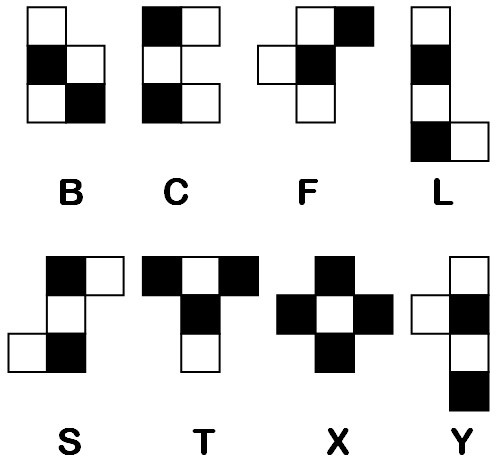
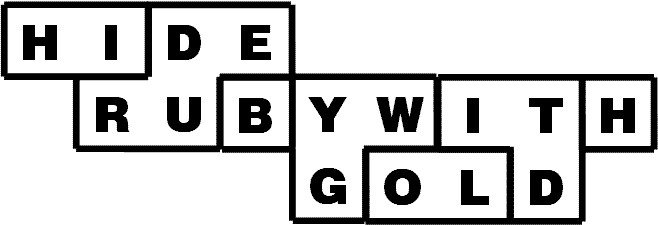
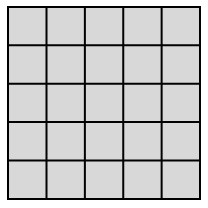 At first sight this puzzle would seem to be nearly impossible to solve without holding the physical pieces in your hands, but let's see how to find a little insight into the nature of the task. INSIGHT: The checkerboard pattern alternates black and white squares. This means that the 5x5 grid will have 12 squares of one color and 13 squares of the other color. The five pieces you choose must match this 12/13 relationship. The following chart will help you decide which pieces to choose: 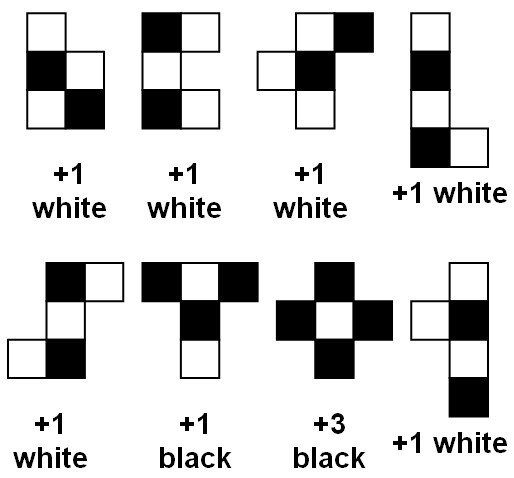 6 of the 8 pieces have one extra white square. The only way to balance the black and white squares is to choose the X (piece shaped like a plus sign) as one of your pieces. If you also choose the T, you will have 13 black squares. Otherwise, you'll have 13 white squares. If you have more white squares than black, you will have white squares in all four corners. This forces the X piece to the center of the board; anywhere else will prevent you from filling a corner with a white square. 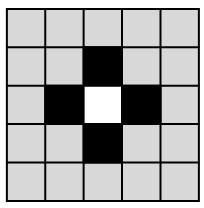 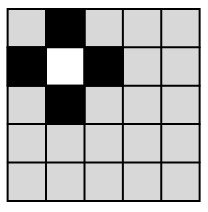 A little trial-and-error experimenting should quickly convince you that there is no way to fill the 5x5 grid with the X in the center. The available shapes can't fill all the corners. Therefore, the pattern needs to have more black squares than white. That means you'll need to choose the T as well as the X. Now you know two of the five pieces and that all four corner squares will be black. Amazingly, We're almost finished! The X will only fit the pattern if you place it up against the middle of one of the edges; the edges are symmetrical, so it doesn't matter which one. 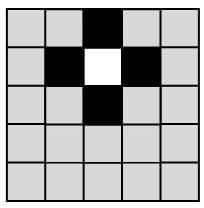 You will need two hook-shaped pieces to wrap around the X and fill the corners. The only two pieces that match that description are the C and the L. Remember that we must use the T-shaped piece. Place the T upside down in the lower right corner to be sure that a black square is in the corner. The remaining space conveniently holds the B piece. 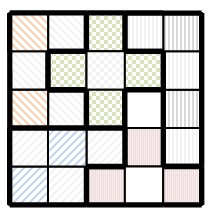 The puzzle is solved! Tip Number 2.Break a large problem into several smaller ones.To thread your way from the entrance at the top of the maze to the exit at the bottom, you will have to open two doors. Each of the 475 rooms in the diagram has doors that are shown as either opened or closed. You may not go through walls or closed doors. But you can solve the puzzle by opening only two doors. Which two doors should you open? 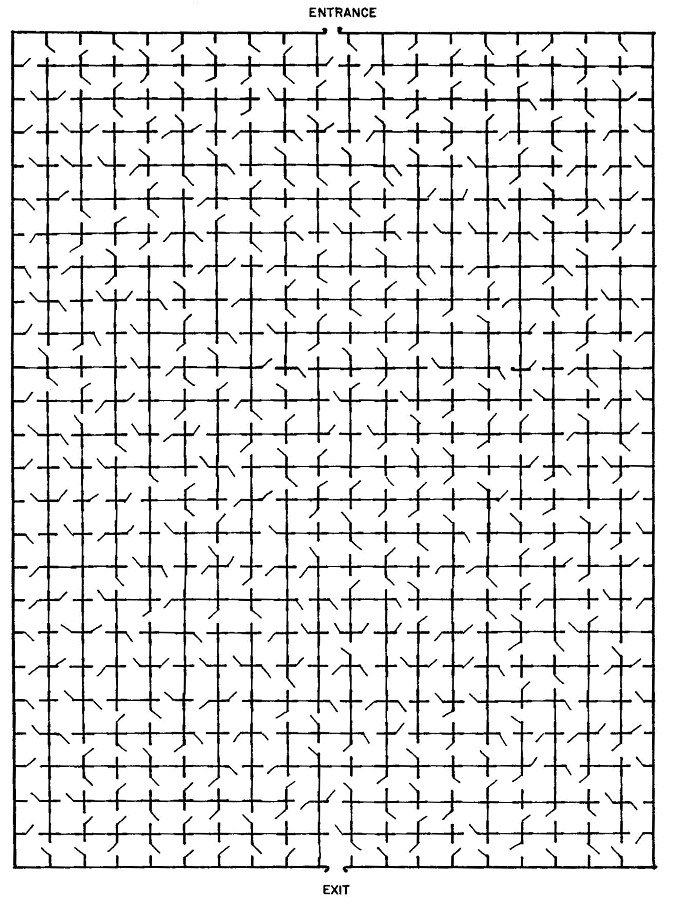 At first sight this puzzle would seem to require hours of tedious trial and error to solve, but let's break it down into simpler pieces. ANALYZE: Let's see all of the rooms we can reach from the entrance without opening any doors. We'll color those rooms yellow. Then we'll use pink to color the rooms we can reach from the exit. 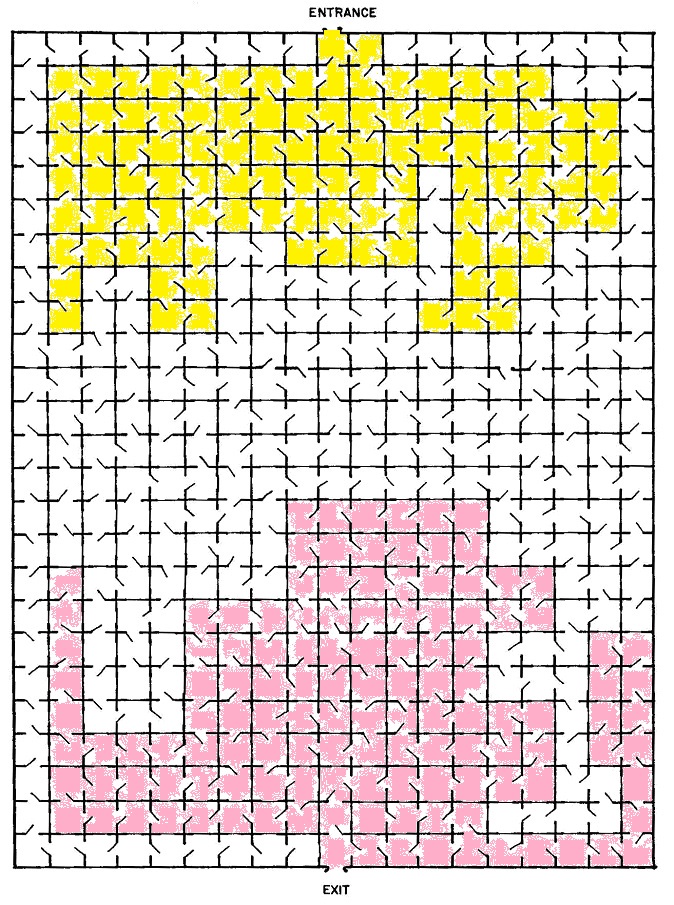 Now all we have to do is find a corridor that connects the yellow and pink areas using two doors. Let's apply some insight (see Tip 1 above). We know the puzzle has a unique solution. Therefore, the connecting corridor cannot be entered from more than one yellow-colored room. We can eliminate any corridor that touches the yellow area from more than one room. Let's color such corridors grey. Voila! We have found the first door (as designated by the red circle). 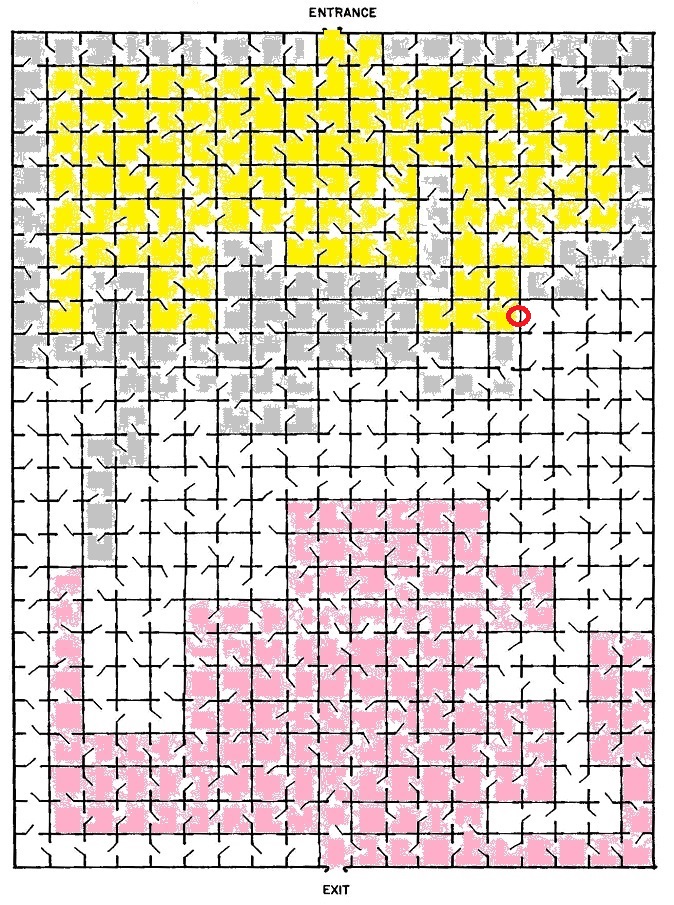 For our final step let's color the connecting corridor blue and see where it leads. Good news: it can reach the pink area at exactly one door (at the second red circle). We've solved the puzzle quickly, and now it's time to celebrate. 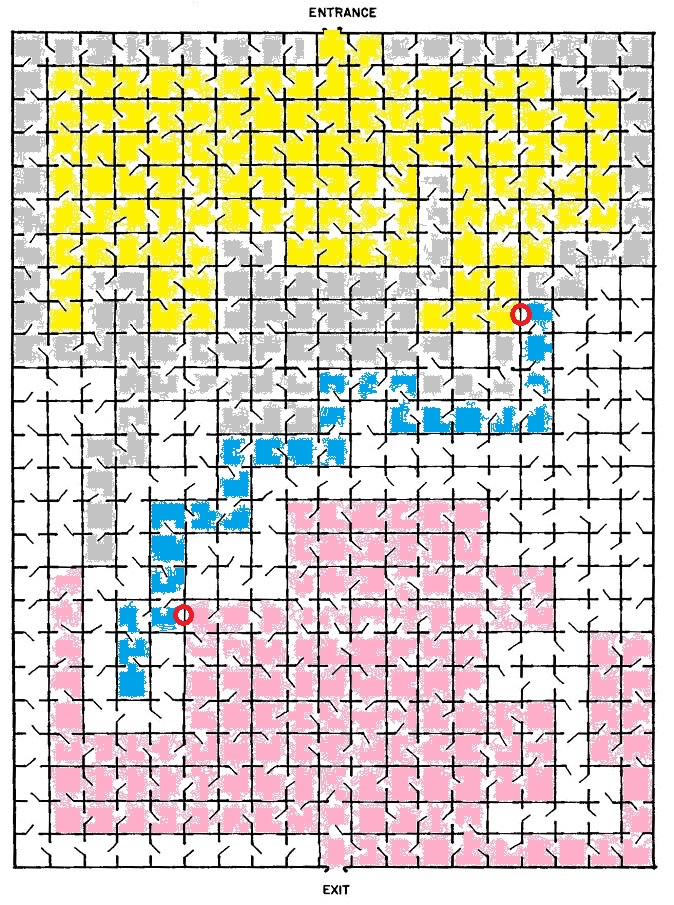 Tip Number 3.Question your assumptions that might be limiting your thinking.Your colleague left you a message. It's an instruction consisting of four four-letter words. He wrote it on a grid of squares and then cut the grid into pieces like a jigsaw puzzle. Your job is to rearrange the pieces and determine the message. 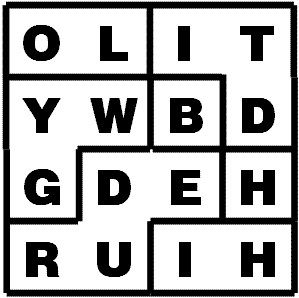 . . . There are two basic approaches to solving this puzzle: . . . Most people who spend any time with either approach fail to make much progress. THINK OUTSIDE THE BOX: Let's start with approach number 2 and try to form four words. English doesn't have a common four-letter word that contains "YW." It certainly doesn't have one that can be formed with the pieces given. Instead, let the "Y" be the last letter of one word and "W" be the first letter of another. This means the solution won't be a square. The puzzle is designed to coax you into assuming the answer forms a 4x4 grid of letters. That is the assumption we must abandon. We must think outside the box, literally. .. . . We try several words starting with "W", but only 'with' seems to work. The word below 'with' has the pattern G _ _ D, and the word 'gold' fits nicely. One more trick trips up solvers at this point: the "IH" must be turned upside-down and combined with "DE" to get 'hide.' That leaves 'ruby' as the second word. Our colleague's instructions tell us to hide the ruby with the gold. The message has a 'shape' outside the 'box.'
 Tip Number 4.Guess the answer, and then see if it works.This technique is often called the 'What-If' approach. For example, in sudoku you may have determined that a particular square is either a 4 or a 6. Suppose (what if) it is a 6; then see if that leads to a valid solution or to a contradiction. I find that complex logic problems can sometimes be completed by guessing the answer. After applying all the clues I often come down to a pair of possible answers. For example, I know that Mr. Jones is either Bob or Carl. I'll guess that Carl is Mr. Jones. That would mean that Bob is Mr. Smith. If this guess leads to a contradiction, then I should have chosen Bob Jones and Carl Smith. If Carl Jones leads to a valid solution, I'm done. Solving cryptograms uses this approach almost exclusively. You look for patterns and letter frequencies, but you ultimately try some guesses to see where they lead. I made up two one-liner jokes based on familiar phrases. I then encrypted the quips using the same substitution cipher to create a pair of cryptograms. Your puzzle is to decode them.
. . . A time-honored technique for solving a substitution cipher like this is to do a 'frequency analysis' -- that is, to count up how often each letter appears in the message. However, that approach involves tiresome work. Instead, let's see if guessing can be faster and more fun. .. . . Notice that there is a common three letter word (JNM) that occurs three times in the second line. Let's guess that JNM represents the word THE. Several longer words start with these three letters; they could be THERE or THESE or THEY or THEM. Let's try substituting THE for JNM. X EeFFG KBS GBQS thBQOhtU - X ZBIIXS RK GBQ ESBDRUe FBt tB UhXSe theD YhRIe R'D eXtRFO.theSe'U IROht Xt the eFZ BK the tQFFeI, HQt theSe'U SeOQIXS HeeS RF the KSRZOe. Our guess yields encouraging results. Let's continue. The two letter word starting with T is surely TO. So B represents O. The first word in the second line now seems to be THERE'S. X EeFFG Kor GoQr thoQOhts - X ZoIIXr RK GoQ EroDRse Fot to shXre theD YhRIe R'D eXtRFO.there's IROht Xt the eFZ oK the tQFFeI, HQt there's reOQIXr Heer RF the KrRZOe. All of these substitutions look reasonable so far. The K (in Kor) is probably F. The QO in thoQOhts should probably be replaced to make THOUGHTS. Those substitutions point to G representing Y. X EeFFy for your thoughts - X ZoIIXr Rf you EroDRse Fot to shXre theD YhRIe R'D eXtRFg.there's IRght Xt the eFZ of the tuFFeI, Hut there's reguIXr Heer RF the frRZge. Suddenly the context suggests that the first line starts: A PENNY FOR YOUR THOUGHTS. If X=A, then R probably represents I (R'D would be I'M). a penny for your thoughts - a ZoIIar if you promise not to share them YhiIe i'm eating.there's Iight at the enZ of the tunneI, Hut there's reguIar Heer in the friZge. The second line starts THERE'S LIGHT AT THE END OF THE TUNNEL. And everything else seems to fall into place. A penny for your thoughts - a dollar if you promise not to share them while I'm eating.There's light at the end of the tunnel, but there's regular beer in the fridge. Tip Number 5.Set it aside.This technique is often called the 'Sleep On It' approach. When you hit a wall and can't think what to do next, set the puzzle aside for a few hours or even a few days. I am continually amazed how easy some problems become when I pick them up again after a time delay. Perhaps my subconscious mind has been addressing the issue, but a fresh look is often all I need to solve the puzzle. Also, studies show that people may have better logical thinking at one time of day and better creative thinking at another.
Pattern Recognition puzzles respond particularly well to this technique. They require creative thinking, and they don't often yield to logical or brute force efforts. What do the initials stand for in each of the following phrases? The numbers should help provide clues. 8 P in a G 26.2 M in a M 48 S in the C U S 206 B in the H B -273.15 D C is A Z 300 P is a P G in B . . . . Perhaps you will quickly arrive at a great answer for each set of initials, but some of the answers to puzzles like this don't come to mind immediately. If you set the puzzle aside, answers may jump out at you when you return to it. All types of puzzles can benefit from this approach. Try coming back to a vexing puzzle, and see if it helps you.
. The answers I intended for this puzzle are shown below. .. . . 8 pints in a gallon 26.2 miles in a marathon 48 states in the continental United States 206 bones in the human body -273.15 degrees Celsius is absolute zero 300 pins is a perfect game in bowling Tip Number 6.Cheat. Okay, I suspect you won't like this one, but please take a minute to consider my logic.First let me define what I mean by cheating: Looking up a hint or an answer at the back of the book, or asking a friend or the Internet for help. Of course, these methods can often lead to an immediate solution, but where's the fun in that? I think puzzles should be FUN, but if you are hopelessly stuck or face mounds of tedious work, how can it be fun? So I only urge you to 'cheat' when two conditions exist: Suppose you're solving a crossword puzzle, and one of the Across clues is not something you would ever know. So you work the Down clues to flesh out the answer. However, one of the intersecting Down clues also requires knowledge you just don't have. Now there is a square in the grid that remains a mystery. Don't fight it; just look it up. This keeps the puzzle more fun and helps you learn those bizarre words and definitions that only crossword solvers seem to know. I hope that you already do this kind of cheating, but you now have at least one source saying that it is okay. Besides, if you are not competing with other solvers, no one will ever know that you avoided frustration by 'researching' the answer. We hope these tips have helped you get more fun out the puzzles that, at first, seem much to difficult. |
All Rights Reserved.
Copyright © 2023 William Armstrong
39864 Golfers Drive, Palmdale, CA 93551 USA